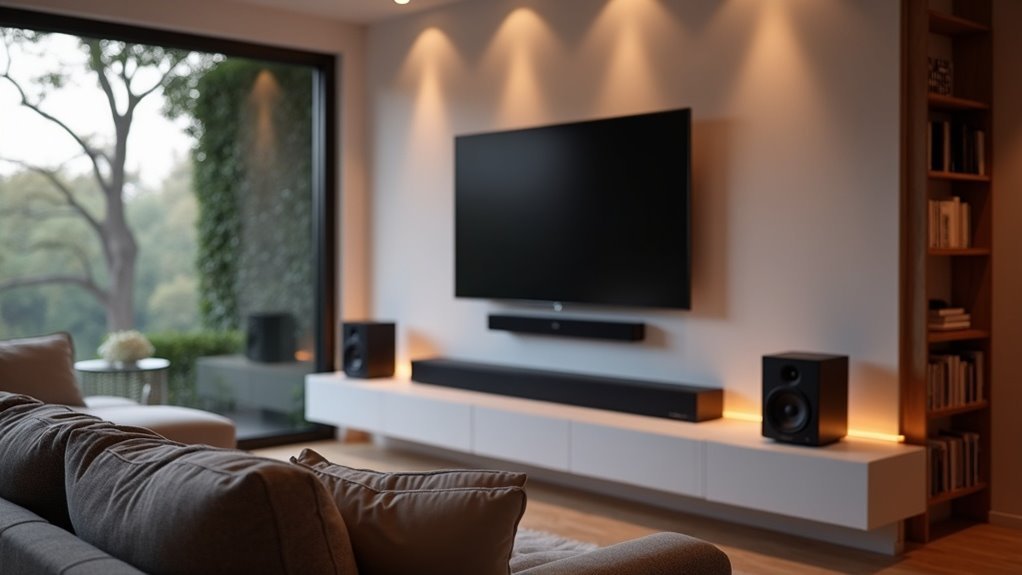
To choose a soundbar channel count that suits your room size, consider that small rooms (up to 200 sq ft) work well with 2.0 or 2.1 setups, providing clear sound without overwhelming the space. For mid-sized rooms (up to 340 sq ft), 3.1 or 5.1 configurations offer enhanced clarity and immersion, making them ideal for a more engaging audio experience. In larger spaces (500 sq ft+), a minimum of 5.1 channels is recommended to ensure optimal sound distribution. Additionally, assess your room’s acoustics and speaker placement to maximize audio performance, and explore further insights on selecting the right soundbar setup for your needs.
Key Takeaways
- Small rooms (up to 200 sq ft) benefit from 2.0 or 2.1 setups for balanced audio and bass enhancement.
- Mid-sized rooms (up to 340 sq ft) are best suited for 3.1 or 5.1 configurations to improve dialogue clarity and immersive experiences.
- Larger rooms (500 sq ft+) require at least a 5.1 setup to optimize sound, with 7.1 or 7.1.4 enhancing audio immersion.
- Consider room acoustics; soft furnishings improve sound clarity while irregular dimensions may need acoustic panels for better sound distribution.
- Ensure proper soundbar placement avoids walls and reflective surfaces to minimize distortion and maximize audio performance.
Understanding Soundbar Channel Counts
When you’re considering a soundbar, understanding the channel count is essential to achieving the best audio experience for your space.
Understanding the channel count of a soundbar is key to maximizing your audio experience in any space.
Soundbar channel counts, such as 2.0, 2.1, 5.1, and 7.1.4, directly affect audio quality and immersion. A 2.0 setup offers basic stereo sound, while a 2.1 adds a subwoofer for enhanced bass.
For larger rooms, a 5.1 channel setup delivers surround sound with five speakers and a subwoofer, ideal for movies and gaming.
High-end 7.1.4 configurations utilize upfiring speakers to support Dolby Atmos, creating a truly immersive experience tailored to dedicated home theater environments.
Understanding these configurations will help you choose the right soundbar for your needs.
Matching Channel Count to Room Size
When selecting a soundbar, it’s crucial to consider your room size to ensure optimal audio performance.
In smaller spaces, a 2.0 or 2.1 channel soundbar is adequate, while mid-sized rooms benefit from a 3.1 or 5.1 channel configuration for improved clarity.
For larger areas, a 5.1 or 7.1 channel soundbar is recommended to prevent sound loss and enhance immersion.
Matching the channel count of your soundbar to your specific environment is essential for the best sound experience.
Small Room Recommendations
In a small room of 200 square feet or less, selecting the right soundbar channel count is essential for achieving ideal audio performance.
A compact 2.1-channel soundbar is typically recommended for balanced audio and enhanced bass performance, while a 3.1-channel soundbar might be preferable if clear audio and dialogue clarity are priorities.
Consider options like the user-friendly Bose TV Speaker, designed for effective sound enhancement.
Wireless subwoofers also work well in compact environments, offering placement flexibility without cluttering your space.
- Opt for a 2.1-channel soundbar for balanced sound.
- Choose a 3.1-channel soundbar for enhanced dialogue clarity.
- The Bose TV Speaker is a great choice for simplicity and ease of use.
- Wireless subwoofers provide flexibility in placement without taking up extra space.
Medium Room Suggestions
Selecting the right soundbar channel count for a medium-sized room, typically around 340 square feet, can significantly enhance your audio experience. For optimal dialogue clarity, a 3.1 channel soundbar is recommended. If you’re looking for a more immersive sound for movies or gaming, consider a 5.1 channel soundbar with surround sound capabilities. Models that feature upward-firing speakers can help distribute sound evenly throughout the space. Additionally, built-in room calibration can further enhance performance based on your room’s acoustics. Ensure that the soundbar’s width is compatible with your TV for a balanced aesthetic.
| Channel Count | Key Features | Ideal Use |
|---|---|---|
| 3.1 | Enhanced dialogue clarity | TV shows and music |
| 5.1 | Surround sound with subwoofer | Movies and gaming |
| 1 channel | Basic audio | Small setups or budget |
Large Room Considerations
Achieving ideal sound quality in large rooms, typically over 500 square feet, necessitates a soundbar with a minimum of 5.1 channel configuration.
Here are key considerations:
- Opt for larger soundbars, like 7.1 or 7.1.4 channels, for enhanced immersive audio.
- Choose models with upward-firing drivers to maximize Dolby Atmos effects.
- Incorporate separate subwoofers to improve low-frequency response and sound coverage.
- Look for soundbars equipped with room correction technology to adapt to your room’s acoustics.
These features ensure your audio experience is powerful and clear, transforming movie nights and gaming sessions into true cinematic events.
Benefits of 2.1 Channel Soundbars
A 2.1 channel soundbar offers a compelling audio solution for those looking to enhance their audio experience beyond standard TV speakers. This configuration features two main speakers and a dedicated subwoofer, delivering improved bass performance that enriches both TV audio and music playback.
Ideal for small to medium-sized rooms, it significantly boosts sound quality, enhancing dialogue clarity and sound effects. The compact design allows for easy setup, often making it a more practical choice compared to larger multi-channel systems.
With a price range between $100 to $500, a 2.1 channel soundbar provides a cost-effective way to elevate your audio experience without breaking the bank.
Advantages of 5.1 and Higher Channel Configurations
For those seeking an immersive audio experience, soundbars with 5.1 channel configurations and higher offer significant advantages over simpler setups.
These systems enhance your surround sound experience by providing powerful sound distribution and clearer dialogue.
- Supports advanced audio formats like Dolby Atmos for a cinematic experience
- Creates a realistic audio landscape with pinpoint sound placement
- Improves clarity and immersion, essential for movies and gaming
- Ideal for larger rooms, ensuring cohesive audio coverage throughout the space
Considerations for Subwoofers
When selecting a soundbar, understanding the types available is essential for optimizing your audio experience.
Placement also plays a significant role in achieving the best sound performance, as it affects soundwave interaction within your room.
Subwoofer Types Explained
Two primary types of subwoofers are commonly associated with soundbars: built-in models integrated into the soundbar itself and standalone units that can be placed strategically within a room. Understanding these options can significantly enhance your audio experience.
- Built-in subwoofers: Offer convenient, space-saving designs that complement the slim profile of soundbars.
- Standalone subwoofers: Provide flexibility for ideal placement, allowing you to position them for optimal bass performance.
- Wireless options: Help reduce cable clutter while increasing placement freedom, making them a popular choice for soundbar setups.
- Wired subwoofers: Generally deliver more stable connections and superior sound quality, which can be beneficial for those seeking a robust audio experience.
When selecting a subwoofer for your soundbar, consider your room dimensions and how effectively powerful bass will fill the space.
Choosing the right type of subwoofer can profoundly impact your overall sound experience with your soundbar.
Placement for Optimal Bass
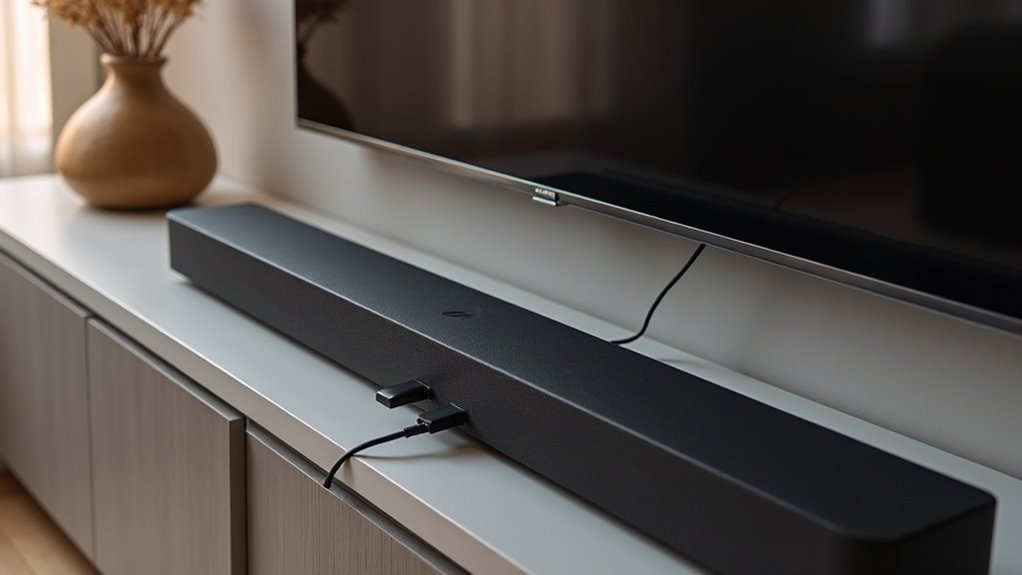
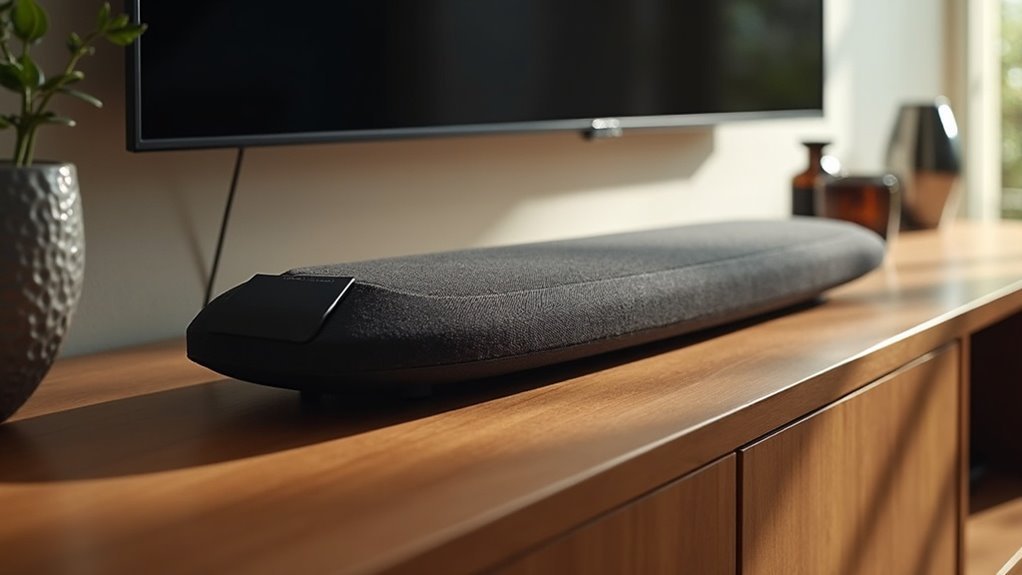
To achieve optimal sound performance from your soundbar, strategic placement within your room is essential. For the best audio experience, position your soundbar at ear level, ideally directly under your TV, to ensure clear dialogue and balanced sound.
Avoid placing it in enclosed spaces, such as cabinets, as this can muffle sound and diminish clarity. Experimenting with placement can lead to significant improvements in sound distribution and quality.
If using multiple soundbars or additional speakers, varied placements can help create an immersive surround sound experience. Incorporating acoustic treatments, such as rugs or curtains, can also enhance sound clarity and improve overall audio performance in any room size.
Evaluating Room Acoustics
While soundbars are often highlighted for their convenience and sleek design, the acoustics of the room they’re placed in significantly impact their performance.
The interaction of sound with your environment can greatly influence audio quality. Keep these considerations in mind:
- Hard surfaces in the room can cause sound reflections, resulting in echoes and a muddled listening experience.
- Incorporating soft furnishings can absorb sound, thereby enhancing clarity and minimizing unwanted reflections.
- Rooms with irregular dimensions may lead to uneven sound distribution, affecting the overall experience.
- Utilizing acoustic panels can help reduce reflections and elevate the sound quality of your soundbar setup.
Importance of Speaker Placement
Room acoustics play a crucial role in sound quality, and speaker placement is vital for maximizing your soundbar’s performance. For ideal audio clarity and surround sound, position your soundbar system appropriately.
In small rooms, a compact soundbar near the TV enhances dialogue without overpowering. In larger spaces, consider a soundbar with advanced features that can simulate a 5.1 or 7.1 setup, expanding the soundstage and counteracting sound loss from distance.
Avoid placing the soundbar against walls or near reflective surfaces to minimize sound reflections that can distort quality. If your soundbar supports Dolby Atmos, look for upward-firing speakers to create height, significantly enhancing your overall audio experience.
Budgeting for Your Soundbar Setup
When budgeting for your soundbar setup, it’s essential to establish a clear range based on your audio needs and preferences.
Entry-level soundbars typically cost under $200, while mid-range options fall between $200-$500. High-end models over $1,000 offer advanced features, including Dolby Atmos support for immersive movie experiences.
- Consider user feedback and expert recommendations specific to soundbars.
- Look for models that include wireless subwoofers for enhanced bass performance.
- Factor in additional costs for accessories like mounting brackets or cables that may be needed for your soundbar setup.
Ensure that your overall soundbar setup aligns with your budget range and desired audio quality for the best experience.